Real engagements across web design, conversion rate optimization, and paid media — the thinking behind each one, and the results it produced.
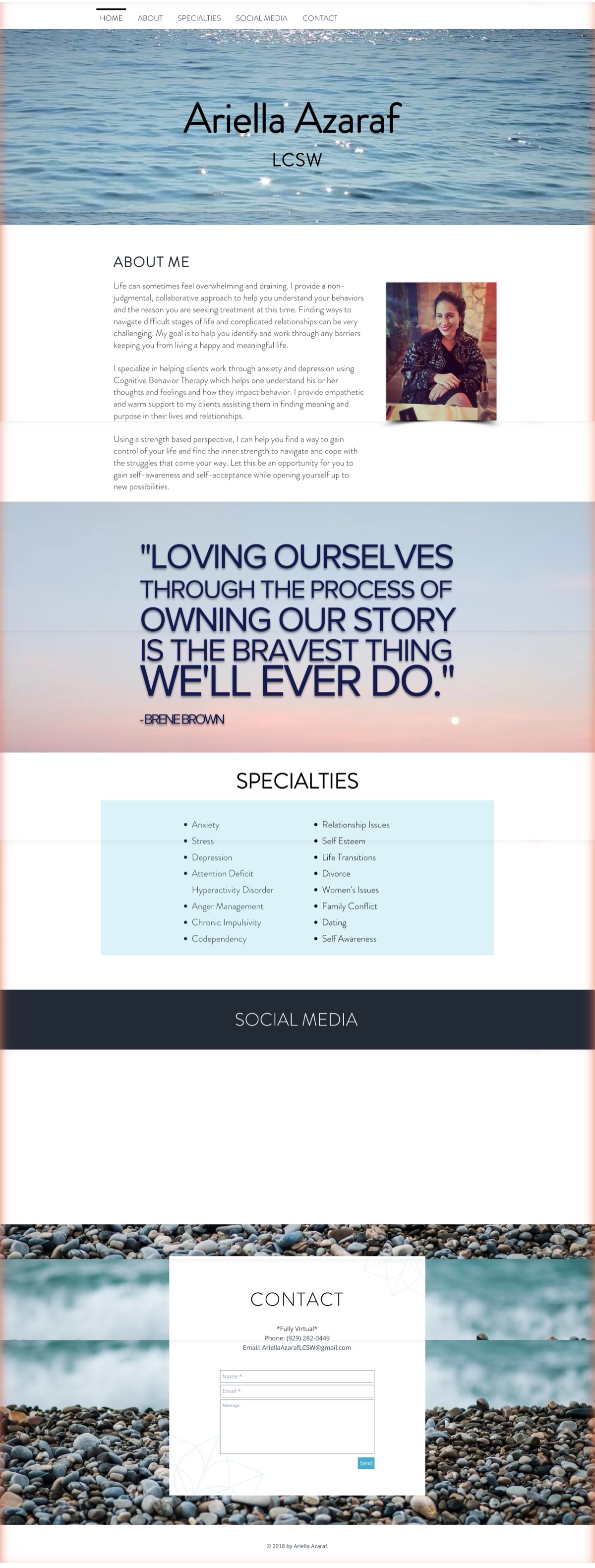
A dated 2018 template site rebuilt from the ground up into a conversion-focused front door for a fully virtual therapy practice.
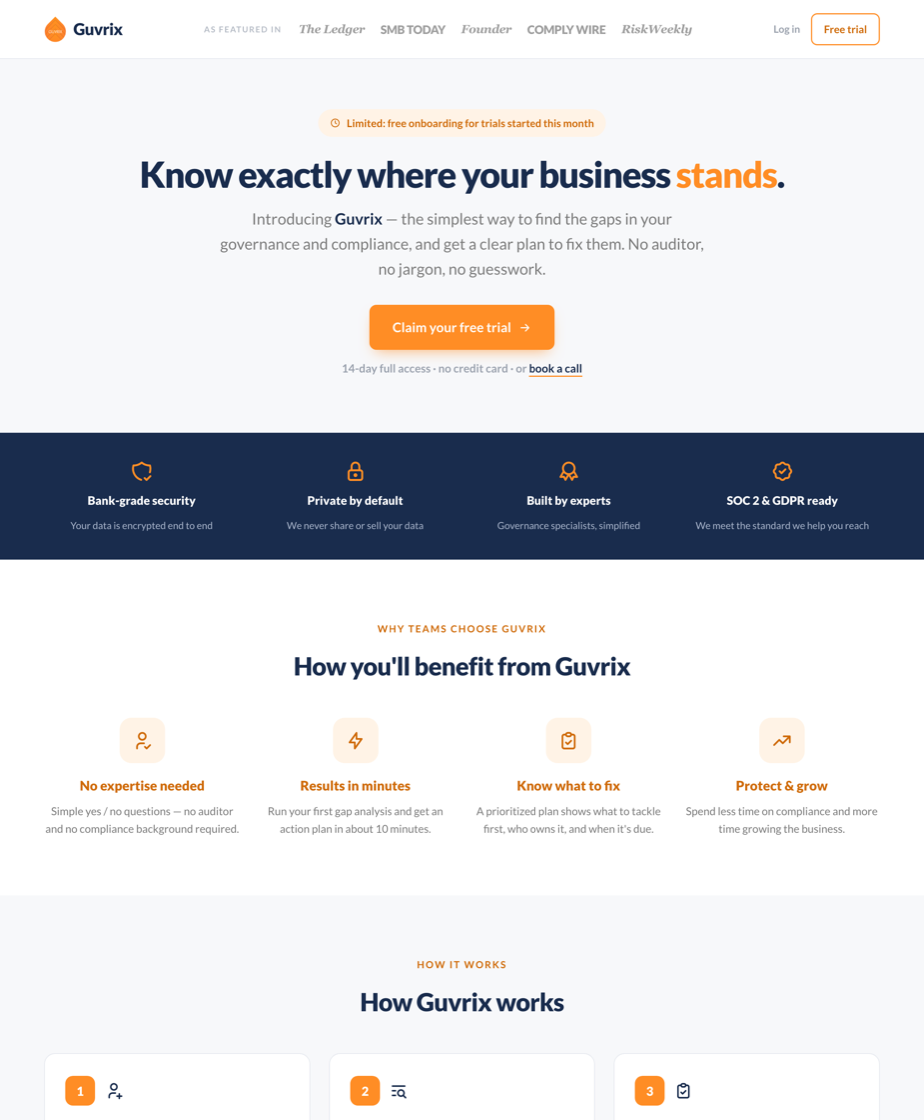
A 10-finding conversion audit — plus a working homepage mockup — that gave a compliance SaaS one clear path to more signups.
A from-scratch practice site with no contact form at all — every CTA opens a WhatsApp conversation, because that’s where the clients already are.
Value-based bidding turned a ~$25K/month account from chasing leads into chasing the leads that become clients.
Bilingual campaigns, purpose-built landing pages, and the sales ops to catch every lead — for an established firm entering three new practice areas.
Broken conversion tracking meant the account was flying blind. We rebuilt it around real revenue — then restructured everything on top.
An inherited $30K/month account in the most competitive treatment market in the country — rebuilt location by location, keyword by keyword.
The conversion data couldn’t be trusted, so we fixed the measurement first — then cut the cost per admit by over a third.
A concentrated, break-even ecommerce account rebuilt from the ground up — from one keyword eating 43% of spend to a lean three-campaign structure.
A from-scratch Facebook lead engine for a real estate agency — Home List ads wired straight into the CRM, so no inquiry slips through the cracks.
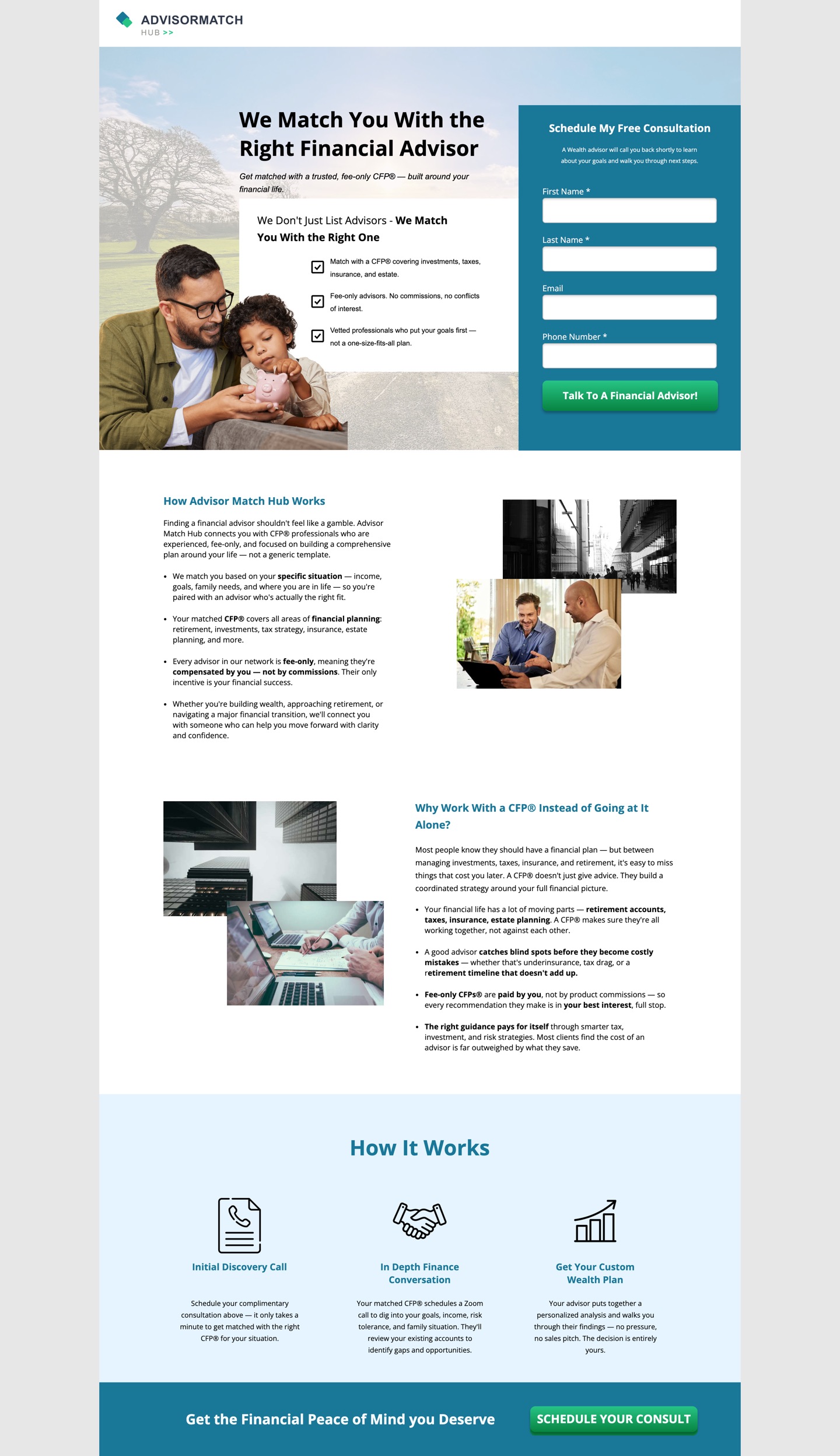
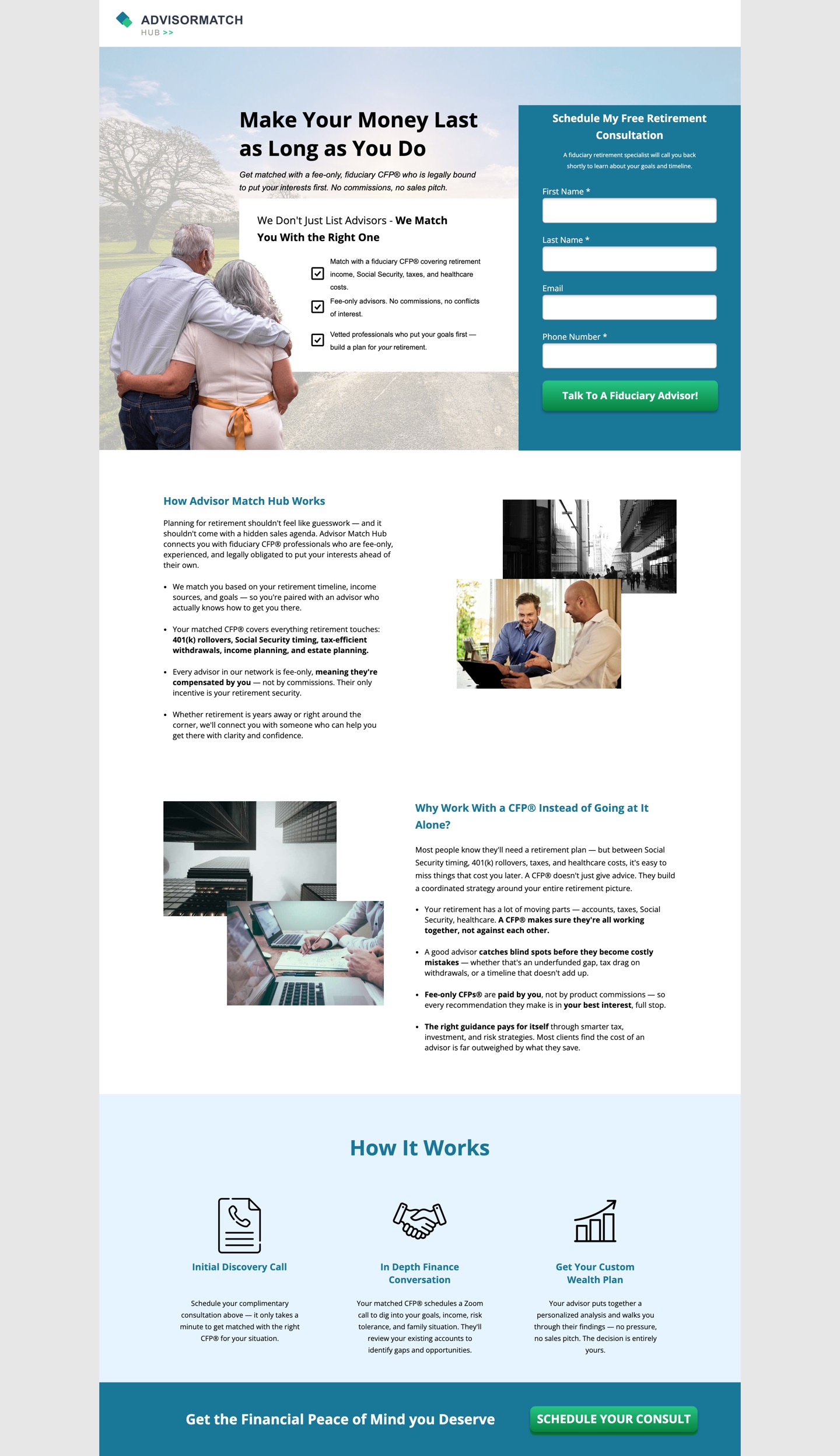
A new Google Ads account and purpose-built landing pages for a fee-only CFP® matching service — structured, tracked and read from a standing start.
Ariella Azaraf is a Licensed Clinical Social Worker with 15+ years of experience, running a fully virtual therapy practice serving clients with anxiety, trauma, relationship and attachment issues. Like many solo practitioners, her website was a template site from 2018 that hadn’t kept pace with her practice.
Ariella’s practice is fully virtual — which means her website isn’t a brochure, it’s the entire storefront. Every prospective client decides whether to reach out based on what they find there. A therapy website has exactly one job: make an anxious, overwhelmed visitor feel understood — and get them to book a consultation. Her old site wasn’t built around that job:
Rather than decorating the old structure, we rebuilt the page around the visitor’s decision journey:
| Before | After |
|---|---|
| No headline | “Healing happens in connection.” |
| No CTA above the fold | “Book a Free 15-min Consult” in hero + nav |
| Credentials absent | 15+ yrs / LCSW / CBT·DBT·trauma-informed snapshot |
| 15-item specialty checklist | 8 specialties with empathetic descriptions |
| Empty “Social Media” band | Featured podcasts & webinars section |
| No insurance info | Transparent out-of-network + superbill FAQ |
The site launched recently, and the transformation is structural: a complete ground-up redesign, a clear booking path that didn’t exist before, and a professional foundation for paid campaigns to land on.
Every ad dollar Ariella spends now lands on a page built to convert. Every podcast listener who looks her up finds a site that matches the caliber of what they heard. And every anxious first-time visitor has a clear, low-pressure next step: a free 15-minute conversation.
See it live ariellaazaraflcsw.com ↗
“Aaron completely transformed my business through his expertise in Google Ads, landing pages, and website design. He fully re-did my website and made the entire process feel seamless. He was incredibly kind, creative, flexible, understanding, and genuinely easy to work with. What stood out most was how intentional he was with every step — he asked such thoughtful, curated questions that helped me gain a much deeper understanding of my niche, brand, and goals. His strategic insight and creativity are unmatched. I highly recommend working with Aaron if you’re looking for someone who truly cares about helping your business grow.”↑ Back to all case studies
Guvrix is a SaaS platform that gives small and mid-size businesses a DIY way to run governance and compliance gap analyses — simple yes/no questionnaires across 150+ topics (data security, GDPR, supply chain, AI policy and more) that produce a prioritized action plan. No auditor, no consultant fees. Their homepage loaded fast and said what the product was — but visitors weren’t converting.
Guvrix had a real product, real pricing, and a fast site (1.39s load). But the homepage was describing the product instead of selling the outcome:
Part 1 — A 10-finding audit, each structured as observation → severity → recommendation. Grounded in established behavioral principles (“users scan, they don’t read”; BJ Fogg’s Behavior = Motivation + Ability), the audit covered performance, first impressions, messaging, CTAs, audience targeting, scannability, psychology, tone, trust signals, and information architecture. Every finding was rated High / Medium / Low / Strength — including calling out what already worked: the headline “Simplifying Governance & Compliance” was kept as a Strength.
Part 2 — A features→benefits translation of the entire product. Simple yes/no questions became “you don’t need to be a compliance expert or hire one — you can run it yourself, today.” Guided gap analysis became “you instantly see where you’re exposed, instead of guessing.” Task owners and reminders became “you’re compliant over time, not just once.” Then every benefit was laddered to the ultimate payoff: Protect (avoid fines, breaches, lost contracts) or Grow (time and energy back into the business).
Part 3 — A working high-fidelity mockup, not just a report. A rebuilt homepage with a benefit-led hero (“Know exactly where your business stands.”), one repeated CTA, a “How Guvrix works” 3-step section right after the hero, a trust band with security badges near decision points, benefit-framed pricing, and an objection-handling FAQ — delivered alongside a prioritized 10-step action plan, sequenced by impact.
This engagement was a methodology deliverable: the audit, the strategy, and a production-ready design — everything needed to implement with confidence. Shipped to the client:
The through-line of every recommendation: stop describing the product, start selling the outcome — and give the visitor exactly one next step.
↑ Back to all case studies
Nosson Menachem Herzka runs Nachamu, a breathwork and meditation practice guiding men through nervous-system regulation and emotional processing — weekly groups, 1:1 work, and online sessions, rooted in his community in Israel. His work spread through word of mouth and WhatsApp groups. There was no website: everything we built, we built from scratch.
The practice was growing — hundreds of men, weekly groups — but there was nowhere to send a newcomer. Every referral ended in a chat message with no page that explained what breathwork is, who Nosson is, and what working with him looks like. For a practice built on trust and word of mouth, the missing link wasn’t marketing — it was a credible home base that could catch the referrals already happening.
We designed and built a single-page site from scratch — hand-coded, deployed on Vercel — around one insight: his clients don’t fill out forms, they send WhatsApp messages. So the site has no contact form at all.
The site launched in July 2026 — a professional web presence where before there was none, with three service paths that each start a real conversation in a single tap.
Every referral now lands somewhere. Instead of a cold group-chat mention, newcomers get the full story — who Nosson is, what the practice does, and a one-tap way to start talking. The site doesn’t replace his word-of-mouth engine; it catches what that engine was dropping.
See it live nachamuspace.com ↗
↑ Back to all case studiesOur client is a multi-state pediatric ABA (Applied Behavior Analysis) therapy provider serving children with autism spectrum disorder, ADHD, selective mutism, and related learning difficulties. They deliver care wherever families need it — in-home sessions, center-based programs at their two clinic locations, in-school advocacy, and parent training — across a five-state footprint in the southeastern U.S.
Their model is built around accessibility: they accept Medicaid, offer weekend sessions for working parents, and staff every case with Board Certified Behavior Analysts supported by Registered Behavior Technicians. At the time of our engagement they were in growth mode, having just opened their second physical center.
One definition matters for everything that follows: in ABA, a family that completes and returns an intake packet is the account’s true “good lead” event — the conversion that actually represents revenue. We refer to these as MQLs, or sent packets.
The practice wanted to stay competitive in an increasingly crowded ABA market while getting maximum efficiency from their budget. Targets were a $100 cost per lead and a $400–600 cost per sent packet. Reality over the trailing six months: ~$25K/month in spend across three states, a $122 cost per lead, and a $723 cost per sent packet — roughly 20–80% over target on the metric that mattered most.
Digging into the account, the gap traced back to structural problems:
In the pilot state, comparing the 60 days after implementing value-based bidding to the 60 days prior:
More of the right families, at a lower cost per family — on the same budget.
The pilot proved the thesis: when the account optimizes for the conversion that actually represents revenue — a family completing an intake packet — the algorithm finds more of the right parents, not just more clicks. The playbook is now the template for every state they operate in.↑ Back to all case studies
Our client is a premier law firm specializing in criminal defense, traffic violations, and personal injury across two neighboring states in the Northeast. The firm has defended thousands of clients, offers free consultations, and holds a stellar reputation — recognized by top legal organizations and backed by extensive positive client reviews.
They weren’t struggling. They were established, respected, and winning in their flagship practice areas. Which is exactly why their next move was harder: growth meant entering markets where they had no established authority.
The firm’s growth plan had three fronts, each with its own gap:
The firm now has a repeatable playbook for entering a new practice area: research the intent, build the page, test bilingual campaigns, and track every lead automatically from click to consultation. The expansion areas aren’t experiments anymore — they’re pipelines.↑ Back to all case studies
Our client is a premier event rental company specializing in high-quality party and event furnishings. With a strong presence in a major metropolitan market, they offer an extensive selection of dining tables, seating, tents, and décor — serving everything from intimate gatherings to large-scale celebrations with a vast inventory and exceptional service.
The account’s biggest problem wasn’t the ads — it was that nobody could trust the numbers underneath them:
Once the account measured real revenue instead of inflated event counts, every downstream decision got easier: budgets followed the product lines that pay, and the bidding optimized toward dollars — not clicks.↑ Back to all case studies
Our client is an outpatient behavioral health treatment center specializing in substance use disorders and co-occurring mental health conditions such as depression, anxiety, PTSD, and bipolar disorder. They offer three levels of care with flexible scheduling — partial hospitalization, intensive outpatient with daytime and evening options, and ongoing outpatient maintenance — alongside individual, group, and family therapy, psychiatric medication management, and free client transportation.
The center is Joint Commission accredited, accepts most major insurance carriers including Medicaid, and positions itself as an independent, patient-centered alternative to corporate treatment chains. They operate a single location in one of the most competitive treatment markets in the country.
We inherited a $30,000/month account with, over the trailing 60 days, a $196 cost per conversion, a $1,438 cost per good lead, and a $5,151 cost per started service in non-branded campaigns. Underneath those numbers:
The restructure is live now. The baseline is on the record — $196 per conversion, $1,438 per good lead, $5,151 per started service — and that’s exactly the point: this account is now built to be measured against it. Results will be published here as the data matures.
In a market with a treatment center on every block, efficiency isn’t a nice-to-have — it’s the difference between an account that fills programs and one that just fills reports.↑ Back to all case studies
Our client is a dual-diagnosis behavioral health provider treating both substance use disorders and co-occurring mental health conditions. They offer a full continuum of care — medical detox, residential inpatient, partial hospitalization, and intensive outpatient — through evidence-based modalities like CBT, DBT, and EMDR alongside holistic services, with specialized programs for populations including veterans and first responders.
The organization operates multiple accredited facilities across two states as part of a larger national health group, is in-network with major insurance carriers, and runs 24/7 admissions. Their marketing operates at serious scale — which is where we came in.
We took over the account with a $95,000 monthly budget that was only spending around $60,000 — and a 90-day trailing record of $193K spent for 105 opportunities at ~$1.7K per qualified lead, and 24 admits at $7.7K per admit. The most pressing issue sat underneath all of it:
Comparing trailing 90-day windows, before the engagement vs two months in:
You can’t optimize spend you can’t measure. Once the account’s numbers agreed with the CRM’s, every dollar had somewhere better to go — and the account produced more admits while spending $73K less.↑ Back to all case studies
Puzzled Gamer is a specialty hobby retailer in Fort Wayne, Indiana, selling jigsaw puzzles, board games, and LEGO building sets — a Shopify catalog of 4,000+ products built around a simple promise: “Build It. Solve It. Play It.” They serve families, casual gamers, puzzle enthusiasts, and collectors, and stand apart from big-box marketplaces with a genuine community layer: a 4.97-star rating, hobby resource guides, and fundraising options.
Over the trailing 90 days, the account had spent roughly $7,400 on Google Ads at a ROAS of about 1x — buying revenue at close to break-even, with no room to scale profitably. The audit traced that flat performance back to a badly concentrated, structurally inefficient account.
We rebuilt the account from the ground up — pausing every existing campaign and replacing the sprawl with three tightly-scoped Standard campaigns, each with a clear job and controlled spend.
To learn faster, both add-to-carts and purchases ran as primary conversions for the first 30 days before add-to-carts dropped to secondary. Rather than guess, we planned a controlled PMax vs. Standard Shopping experiment after week three — scaling into PMax only once it proved it could outperform — with a roadmap to split PMax by price/margin and brand and layer in YouTube and Display remarketing as budget grew.
The rebuild delivered. After launch and hands-on, ongoing optimization — pausing irrelevant keywords, adding qualified audiences, lowering bids on unprofitable products and search terms, and continuously trimming waste — the account’s return on ad spend climbed from 139% to 212%.
An account that had been running near break-even was turned into one returning better than 2x — every dollar of ad spend now generating more than two dollars back, on the same budget. The gains came from disciplined bid management and relentless waste-trimming, not from spending more.
The fix wasn’t a bigger budget — it was a better-built account. Concentrating spend where the data pointed took Puzzled Gamer from break-even to better than 2x return, with room to scale from there.↑ Back to all case studies
Rise Realty is a real estate agency of hands-on agents specializing in residential sales — buying, selling, resale, and fix-and-flip — backed by a team with more than $200M in combined sales experience. Like any growth-minded agency, they run on a steady flow of new buyer conversations, and wanted a modern, predictable way to generate them online: paid social, aimed at buyers in the South Florida market.
The goal wasn’t clicks — it was leads an agent could actually turn into a conversation. Real estate makes that harder than it sounds:
Rather than one-off ads, I built a repeatable Facebook lead-generation system around a single proven format for the South Florida market: the Home List campaign. The ad promises exactly what a buyer wants — a free, curated list of homes for sale in their area, priced to appeal to the widest possible audience — with copy engineered to convert: an audience call-out, a price hook framed as below market, a touch of scarcity, and one unmistakable CTA that opens a Facebook Lead Form.

Behind the creative sat a full system: compliant Special Ad Category targeting across South Florida, Facebook Lead Forms with a qualifying “how soon are you looking to buy?” question, a thank-you screen prompting an immediate call, and a Zapier integration piping every new lead straight into the CRM with an instant notification — built so follow-up could start inside that critical five-minute window.
The deliverable was the engine itself: a repeatable, compliant, fully automated Facebook lead-generation system built from scratch — creative, targeting, lead capture, and CRM routing, end to end. And it produced real demand: in the launch window, the Home List campaign generated roughly 19 buyer leads in about five days, each flowing automatically into a colour-coded tracking pipeline built for fast, organised follow-up.
The win here isn’t a revenue figure — it’s the infrastructure: a working, automated lead-generation and tracking system that Rise Realty can keep running and scale across neighbourhoods and price points, turning cold Facebook traffic into a managed pipeline of real conversations.
↑ Back to all case studies
Advisor Match Hub connects people looking for financial guidance with fee-only CFP® professionals — advisors paid a flat fee rather than commission, and matched to a person’s actual circumstances rather than assigned at random. The offer is a free consultation: a short discovery call, an in-depth finance conversation, then a custom wealth plan. Paid search was brought in to fill the top of that funnel.
A brand-new Google Ads account in one of the most expensive categories in search — and no history to build on.
The account was built so that every dollar could be traced back to a specific intent — and so the first month would produce a decision, not just a bill.
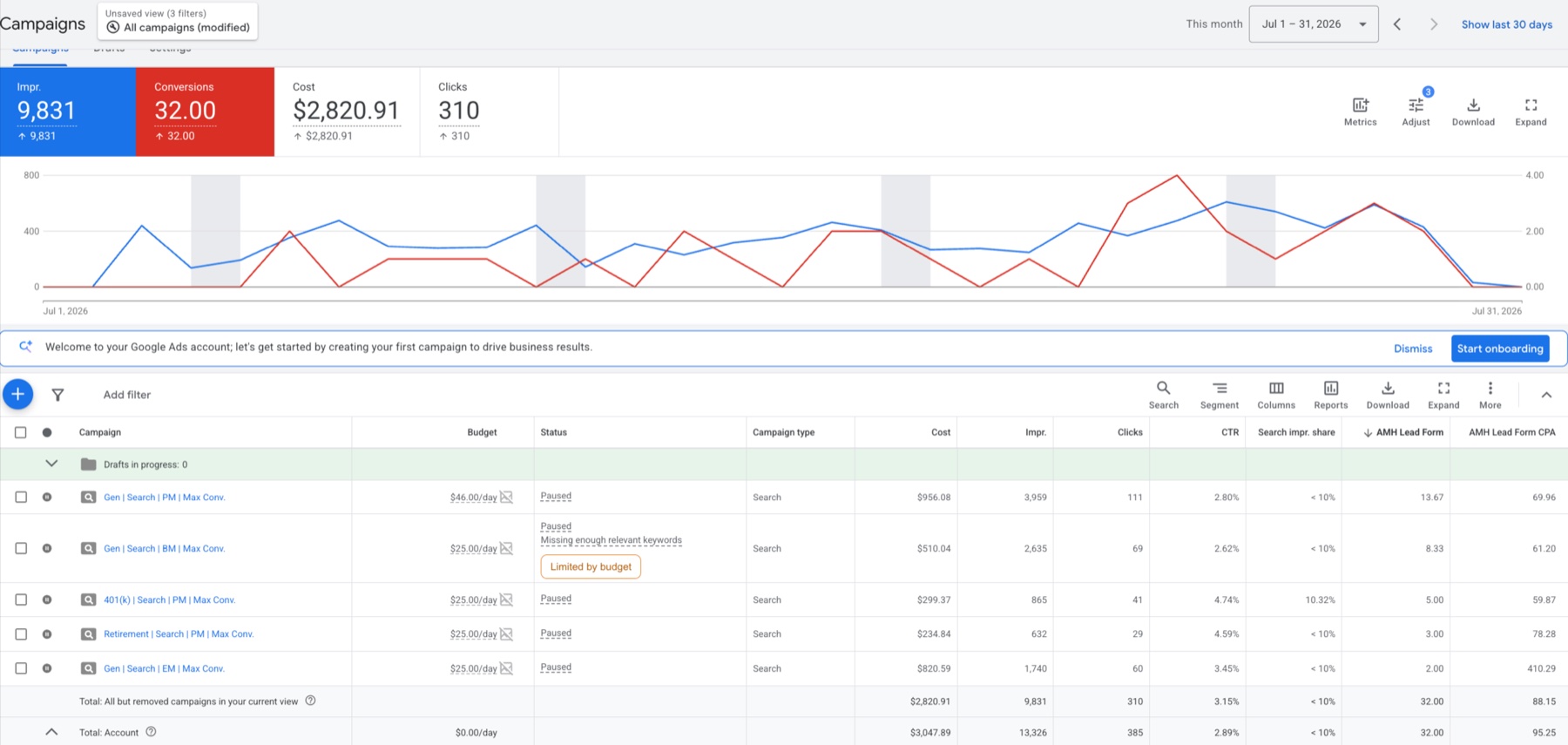
The account produced 32 lead form submissions on $3,047.89 of spend — $95.25 per submission, or $105.10 per valid lead after removing one duplicate submit, one junk entry and one out-of-area enquiry. 91% of submissions carried usable contact details, and the lead records reconciled exactly with tracked conversions: the measurement was correct from the first day. Leads came in from 18 states, on 19 of the 24 days the campaigns produced volume.
Two findings mattered more than the headline cost per lead:
The same segmentation exposed the account’s dead weight just as clearly: one general campaign on exact match absorbed 27% of spend for 6% of the leads. Set that campaign aside and cost per submission falls from $95.25 to $66.68 — which is precisely the decision the structure was built to make obvious.
The account never came close to its ceiling: search impression share stayed under 10% on every campaign, meaning the overwhelming majority of available demand was still unclaimed. Three moves were queued when the campaigns were paused.
The most useful numbers here weren’t the headline ones. A lead rate that doubled on flat budgets, and a 1.6× click-through gap between themed and generic campaigns, say far more about where the account was heading than any single month’s cost per lead.↑ Back to all case studies
Whether you need a site that converts, an audit that finds the leaks, or paid media that pays for itself — let’s talk about your growth.
Get in touch